
Glossary
Mining and industrial supply terms, in plain language
The vocabulary that turns up on data sheets, mine specifications and quotations — defined without jargon so you can specify what you need with confidence.
Conveyors
- Belt cleaner
- A blade or brush system at the head pulley that removes material from the belt to control carry-back.
- Carcass
- The load-bearing structure inside a conveyor belt — the fabric plies or steel cords — under the rubber covers.
- Carry-back
- Material that sticks to the belt past the discharge point and falls off along the return run.
- Cover grade
- The rubber compound of a belt's top and bottom covers, set by a grade letter or class.
- EP belt
- A fabric conveyor belt with polyester (E) warp and polyamide (P) weft plies.
- FRAS
- Fire-Resistant Anti-Static — conveyor belting that resists flame propagation and controls static build-up.
- Idler
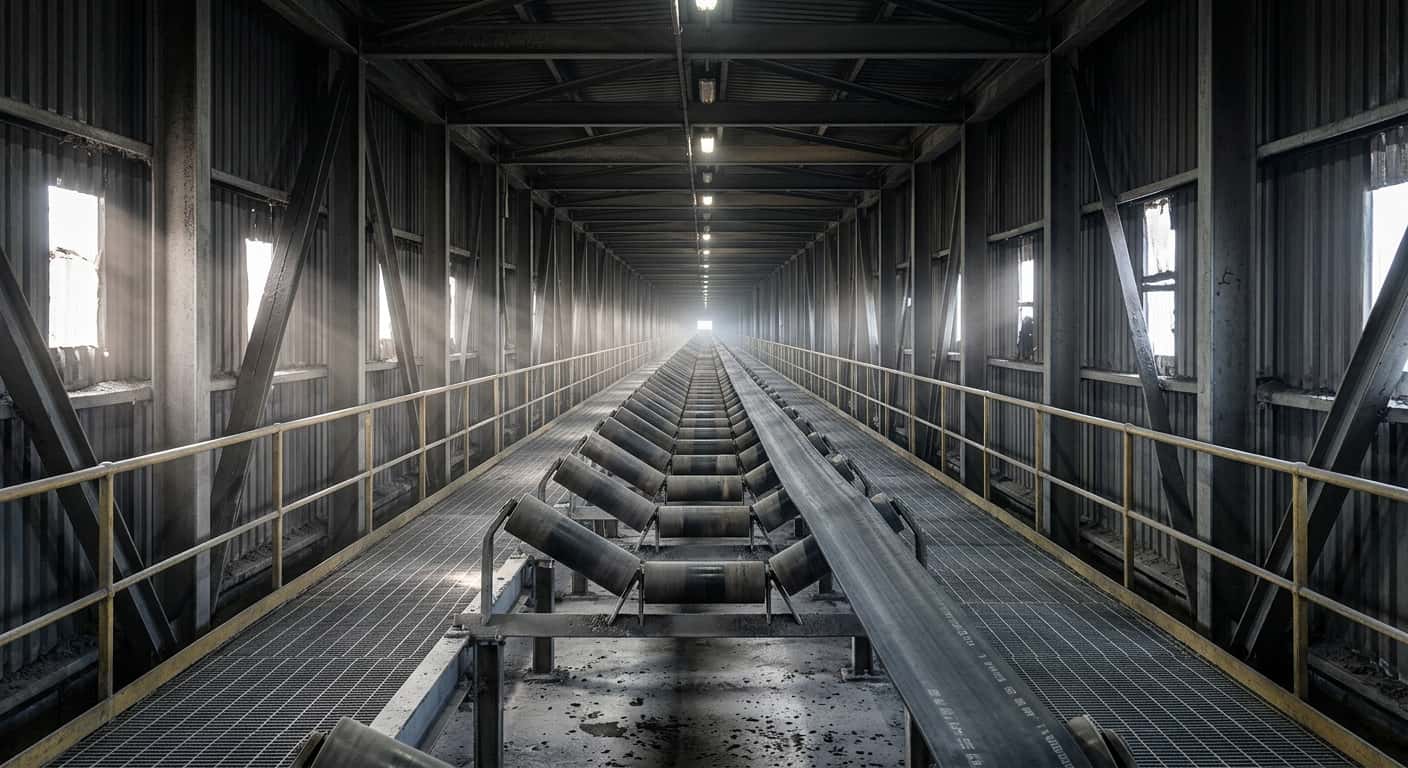
- A set of rolls that supports the conveyor belt along the carry and return runs.
- Mechanical fastener
- A metal or synthetic plate/hinge system that clamps two belt ends together.
- Pulley lagging
- A wear- and grip-enhancing surface bonded to a conveyor pulley — rubber, ceramic or a combination.
- Skirting
- Flexible sealing strips along the load zone that keep material on the belt and dust contained.
- Tensile rating
- The rated full-belt breaking strength of a conveyor belt, in kilonewtons per metre of width (kN/m).
- Transfer point
- Where material is discharged from one conveyor or chute onto another.
- Troughing angle
- The angle of the outer rolls on a carry idler set, which cups the belt to hold more material.
- Vulcanised splice
- A conveyor belt joint made by stepping the plies and curing new rubber under heat and pressure.
Crushing & wear
- Chocky bar
- A hard-facing wear block welded in rows onto chutes, buckets and liners to build a protective wear surface.
- Closed-side setting (CSS)
- The smallest gap in a crusher's chamber during a cycle — the main control on product size.
- Ground-engaging tools (GET)
- The replaceable teeth, adapters, edges and shrouds on an excavator or loader bucket.
- Jaw plate
- The replaceable wear liner on each jaw of a jaw crusher — a fixed plate and a swing plate.
- Mantle & concave
- The two main wear liners in a cone or gyratory crusher — the moving mantle and the fixed concave (bowl liner).
- Screen media
- The panels or mesh in a vibrating screen that separate material by size — woven wire, punched plate, rubber or polyurethane.
Motors & electrical
- Duty type (S1–S10)
- An IEC code for a motor's load pattern over time — continuous, short-time, intermittent, etc.
- Efficiency class (IE)
- An international rating (IE2, IE3, IE4) for the energy efficiency of an induction motor.
- Ex rating
- A hazardous-area certification marking for equipment used where flammable gas or dust may be present.
- Frame size
- A standardised electric-motor dimension code (e.g. 132M, 200L) that fixes the shaft height and mounting.
- IP rating
- Ingress Protection code (e.g. IP55, IP66) for how well an enclosure resists dust and water.
- Variable-speed drive (VSD)
- An electronic controller that varies motor speed by changing the supply frequency.
General
- Incoterms
- Standard trade terms (e.g. EXW, FOB, DAP) that define who arranges and pays for transport, insurance and customs.
- Lead time
- The time between placing an order and the goods being available for delivery.
- MASC
- Mining and Surface Certification — a product and quality-system certification scheme.
- OEM
- Original Equipment Manufacturer — the company that built the machine, or a part supplied in that company's packaging.
- Quality aftermarket
- A replacement part matched to the OEM design and a defined material specification, made by a supplier other than the OEM.
- RFQ
- Request for Quotation — a buyer's enquiry setting out what is needed so a supplier can price it.
Send us your requirement