Product group
Conveyor belting
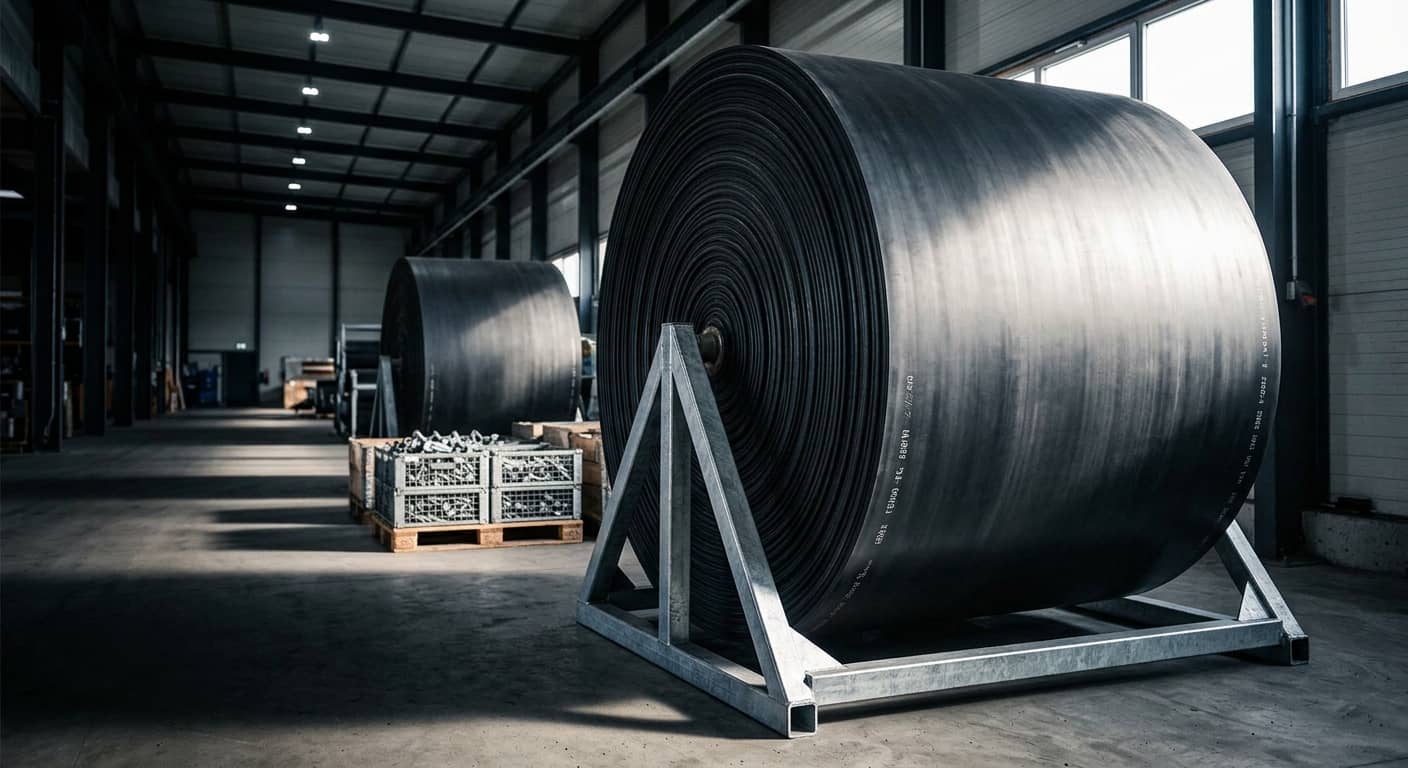
Magnum imported and locally sourced belt, selected to your application
Kia-Kaha Mining supplies conveyor belting for mining, quarrying, bulk handling and industrial plants. We distribute Magnum conveyor belting in South Africa and also supply locally sourced belt. We do not manufacture belt — we help you specify the right construction and cover grade, source it, and get it to site with the matching fasteners, splice materials and pulley lagging. This page is the reference; send your application and our engineer will confirm the belt.
Overview
What conveyor belting is
A conveyor belt is a continuous loop of reinforced rubber (or PVC) that carries bulk material along a supported path. Its performance comes from two things chosen independently: the carcass, which carries the tension and sets impact and splice behaviour, and the covers, whose rubber compound (the grade) sets how long the belt survives the material it carries and the environment it runs in.
Construction
How a belt is built
Belt layers, top to bottom
| Layer | Function |
|---|---|
| Top cover | Abrasion-, impact-, heat- or fire-resistant rubber, selected by grade. Carries the wear; contributes little strength. |
| Bonding / skim layers | Thin rubber layers that bond the covers to the carcass and the plies to each other. Splice quality depends on them. |
| Carcass | The load-bearing structure. Fabric plies (EP, NN/PN, EE) or a single layer of steel cords. Carries the belt tension and sets impact and fastener performance. |
| Bottom (pulley) cover | Thinner cover that protects the carcass against the pulleys and idlers. Grade usually matches or steps down from the top cover. |
Carcass types
| Carcass | Characteristics | Typical use |
|---|---|---|
| EP (polyester / polyamide) | Polyester warp for low stretch and high strength, nylon weft for impact and tear resistance. The general mining default. | Most surface conveyors, aggregates, coal and mineral handling |
| NN / PN (polyamide / polyamide) | Nylon warp and weft — higher elongation, excellent impact, tear and fastener performance. Needs more take-up travel. | Heavy impact, short centres, awkward geometry, mechanically fastened belts |
| EE (polyester / polyester) | Very low stretch in both directions, dimensionally stable. | Long overland conveyors, fixed take-up, precise tracking |
| Solid-woven PVC / PVG | Single-ply woven carcass impregnated with PVC (PVG adds a rubber cover). Rip- and fastener-resistant, inherent fire performance. | Underground coal and hard rock — matched to the mine fire standard |
| Steel cord (ST) | A single layer of high-tensile steel cords in a rubber matrix. Minimal elongation, very high strength, long service life. Vulcanised splices only. | Long overland, high-lift and high-tension conveyors |
Specifications
Typical parameters
Ranges below are typical for the belting we supply. Any figure that must be exact for your conveyor is confirmed against the supplier data sheet on quotation — we do not publish a spec we cannot stand behind.
| Parameter | Typical value / range |
|---|---|
| Belt width | 300 – 2400 mm in standard steps (400, 500, 600, 650, 750, 800, 900, 1050, 1200, 1350, 1500, 1600, 1800, 2000, 2100, 2400) |
| Full-belt tensile rating | Fabric: EP 250 – EP 2000+ kN/m · Steel cord: ST 500 – ST 10000+ kN/m — confirmed on quotation for the exact product |
| Plies (fabric) | 2 – 5 typical |
| Top / bottom cover thickness | Typical 2 – 12 mm / 1.5 – 6 mm — confirmed on quotation |
| Maximum operating temperature | Ambient for GP grades; 125 – 200 °C+ with heat-resistant grades — continuous and peak values confirmed on quotation |
| Minimum pulley diameters | Set by the rating, cover thickness and splice type — confirmed on quotation |
| Splice | Mechanical fastener or hot-vulcanised joint (steel cord: vulcanised only) |
| Standards referenced | SANS 1366 · ISO 14890 / ISO 15236 · DIN 22102 / DIN 22131 · AS 1332 / AS 1333 · SANS 1173 (fire) — compliance stated only against the exact offered product and its current certificate |
Cover grades
Grade families and what they are for
Descriptive grade families
| Code | Name | For | Typical applications |
|---|---|---|---|
| GP | General purpose / abrasion resistant | Everyday abrasion, ambient temperature, moderate impact | Aggregates, coal handling, general plant conveying |
| SAR | Super abrasion resistant | Sharp, coarse, high-impact material | Primary-crushed rock, quarry run-of-mine, load zones |
| HR | Heat resistant | Elevated material temperature | Hot screened product, foundry sand, sinter |
| UHR / SHR | Ultra / super heat resistant | High sustained and peak temperatures | Cement clinker, direct-from-kiln material |
| OR | Oil resistant | Oily or greasy material, hydrocarbon exposure | Treated ore, recycling, some minerals processing |
| FR | Fire resistant | Fire-risk surface conveyors | Portals, enclosed galleries, transfer towers |
| FRAS | Fire resistant anti-static | Underground use with static control | Underground coal and hard rock — matched to SANS 1173 or the mine spec |
Exact grade designations map to a standard — SANS 1366, DIN 22102 (W / X / Y) or ISO 10247 — and the minimum tensile, elongation and abrasion values that go with them. The exact designation and certificate for the belt offered are confirmed on quotation. Full explanation: conveyor belt cover grades explained.
Profiles and special belts
| Type | What it is for |
|---|---|
| Chevron / cleated | Moulded V- or U-cleats that hold material on steeper inclines, roughly 18° – 40°. Cleat heights from about 15 mm to 32 mm. |
| Sidewall + cleat | Corrugated sidewalls with transverse cleats for steep to near-vertical conveying, 40° – 90°, in a small footprint. |
| Pipe conveyor belt | Formed into a closed tube along the carry run — spillage- and dust-free, tighter horizontal and vertical curves. |
| Rough-top | High-friction moulded top surface for package handling and inclined transfer. |
| Bucket-elevator belt | Reinforced belt drilled or prepared for bolted elevator buckets, for vertical lift of bulk material. |
Related: chevron & cleated belts: profiles and incline angles · sidewall belts for steep and vertical conveying
Selection
How we select the belt with you
Send us as much of the following as you have. Partial information is fine — our engineer will come back with the questions needed to finalise the spec, or attend site for an engineering assessment where the belt keeps failing and the cause needs diagnosing first.
- 01Belt width, and the total length or the full conveyor geometry (head/tail centres, pulley diameters, take-up travel)
- 02Whether you need the belt endless (factory-spliced) or open (spliced on site)
- 03Material: type, bulk density, maximum lump size, temperature at the loading point, moisture, and any oil or chemical exposure
- 04Conveyor: incline angle, belt speed, throughput (tph), drive arrangement, and the number and diameter of pulleys
- 05Environment: above ground or underground, and the exact fire-performance standard and clause your mine specification calls up
- 06If replacing: the existing belt spec or side markings, a photo of the belt edge and carcass, and a sample if possible
- 07Commercial: quantity, whether it is a breakdown or a planned change-out, the required date and the delivery location
Applications
Where we supply belting
- Mining — coal, iron ore, gold, platinum and PGMs, manganese, chrome, copper, diamonds
- Quarrying and aggregates — crushing, screening and stockpile conveying
- Cement and lime — raw feed, clinker and finished-product handling
- Power generation — coal and ash handling
- Ports and terminals — ship loading, stockyard and reclaim conveyors
- Steel and ferroalloys — high-wear, high-temperature material handling
- Recycling, waste and industrial plants
Choosing
Fabric vs steel-cord — the trade-off
| Factor | Fabric (EP / NN) | Steel cord |
|---|---|---|
| Strength ceiling | To ~2000 kN/m | To 10000+ kN/m |
| Elongation | Higher — more take-up travel | Very low — suits long overland with fixed take-up |
| Impact / gouge | Good, especially NN/PN | Good, but a breached cover risks cord corrosion |
| Splicing | Mechanical fastener or vulcanised | Vulcanised only |
| Pulley sizes | Smaller | Larger |
| Relative cost | Lower | Higher |
| Best for | Most plant, mobile and shorter-centre conveyors, and breakdowns | Long overland, high-lift, high-tension conveyors |
Buyer questions
Common questions
Belt tools
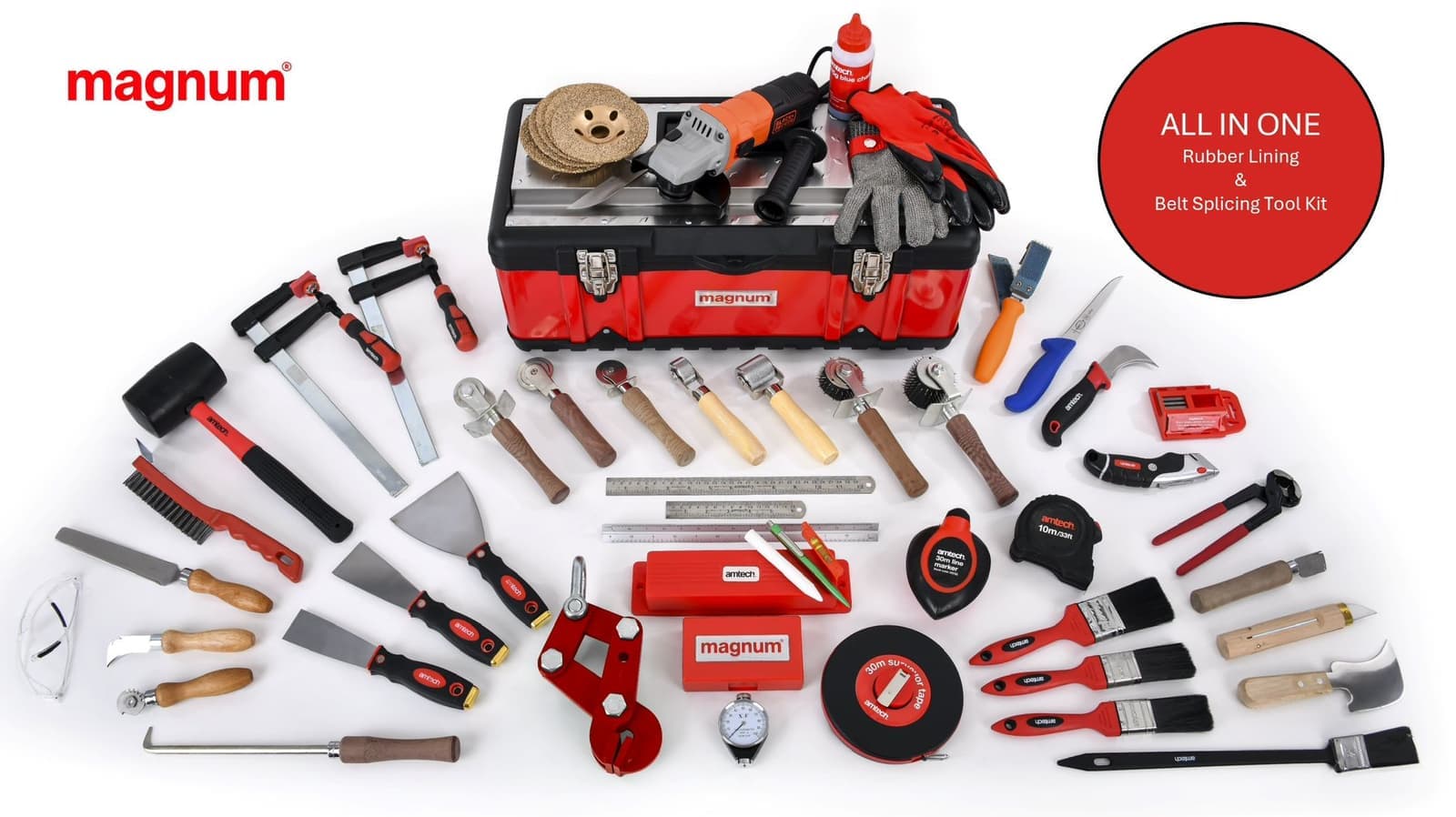
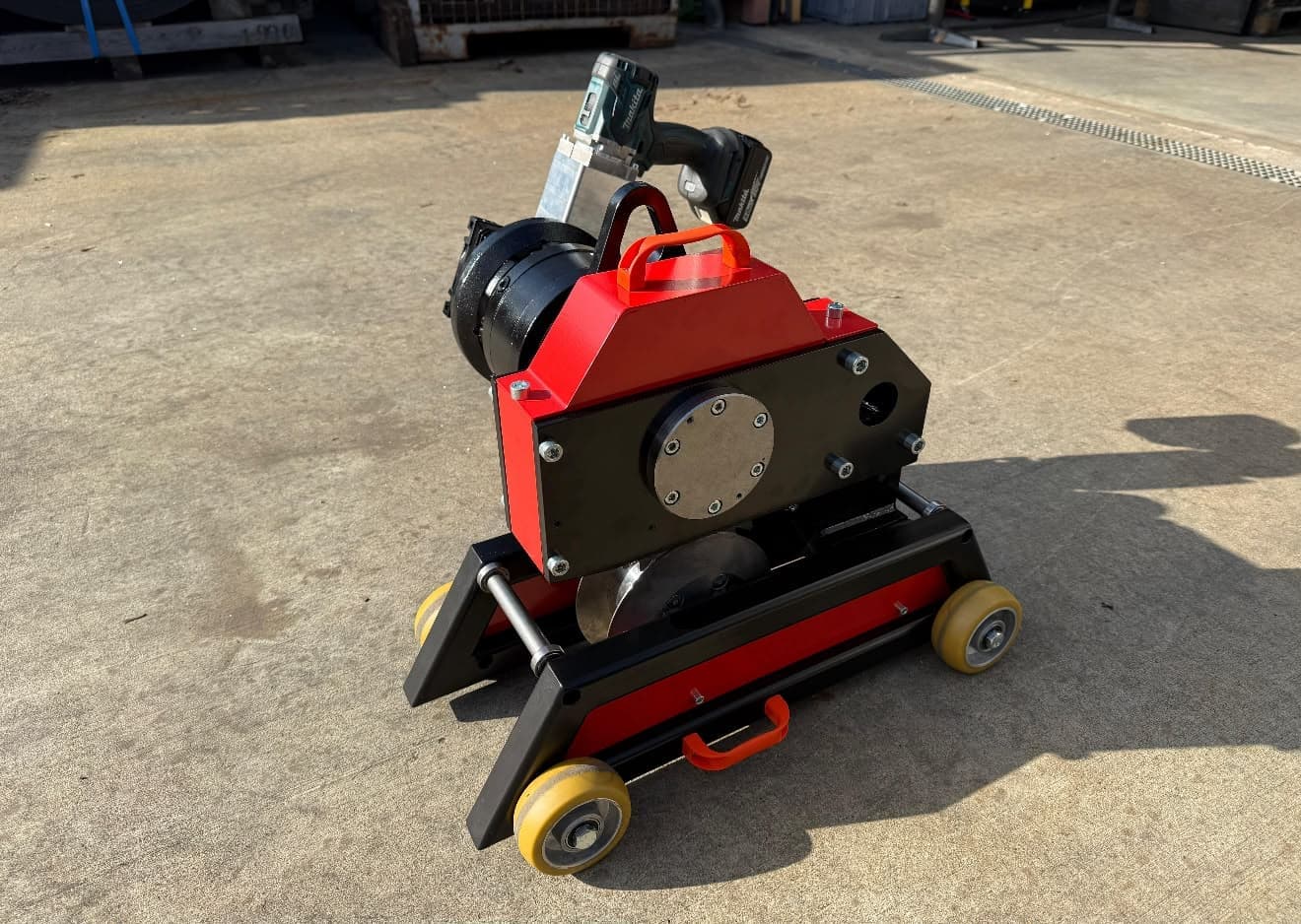
Belt cutting and splicing tools — Magnum
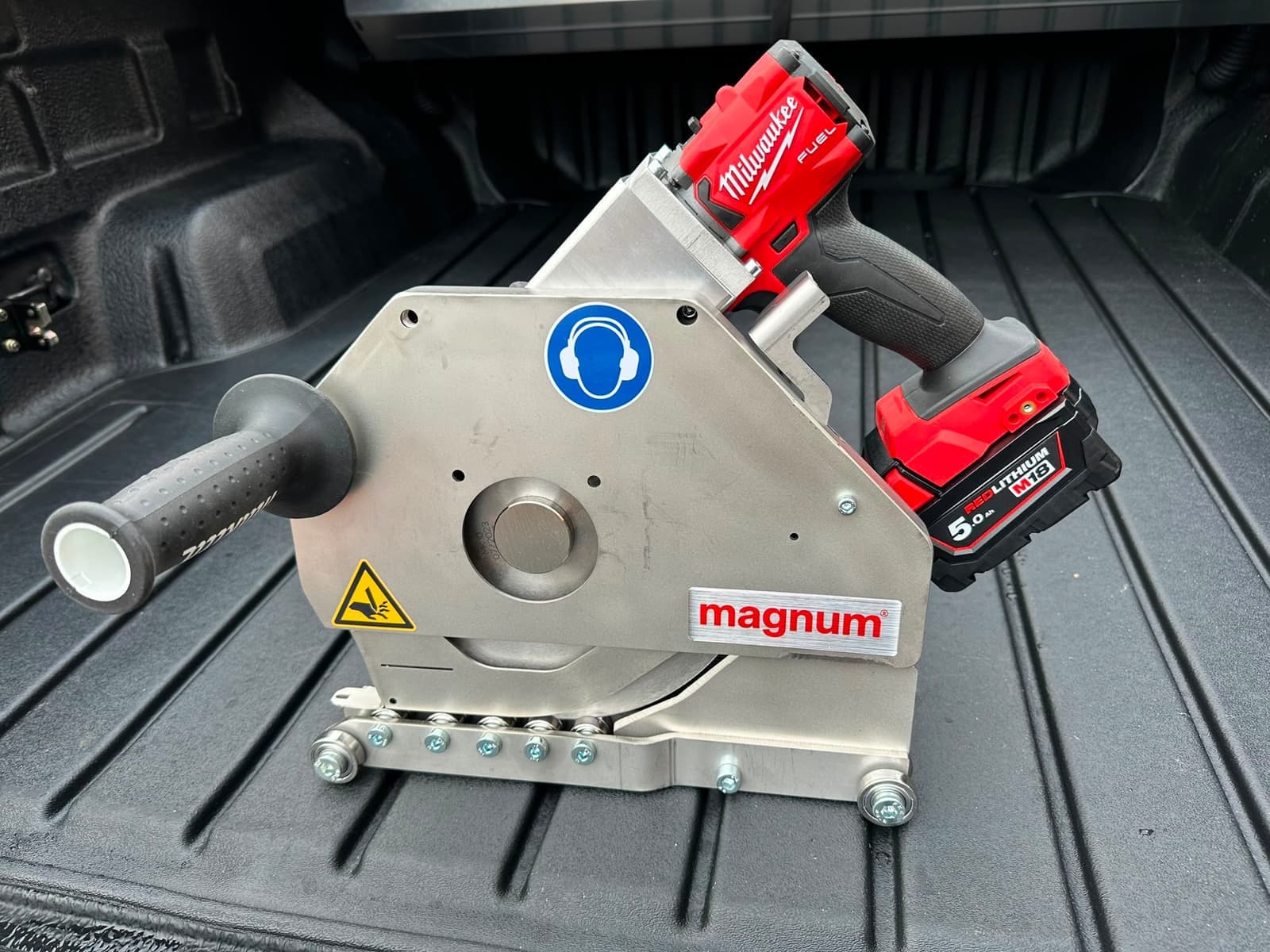
Alongside the belt, Kia-Kaha Mining supplies the Magnum belt-cutting, rubber- lining and splicing tool range — from the complete all-in-one splicing tool kit to the powered belt cutter that trims steel-cord and fabric belt square on site, driven off a cordless drill.
Related
Request a quote
Send your belt application
Not sure which construction or cover grade you need? Send the conveyor and material details — our engineer will specify the correct belt and quote it with the matching fasteners and splice materials.