
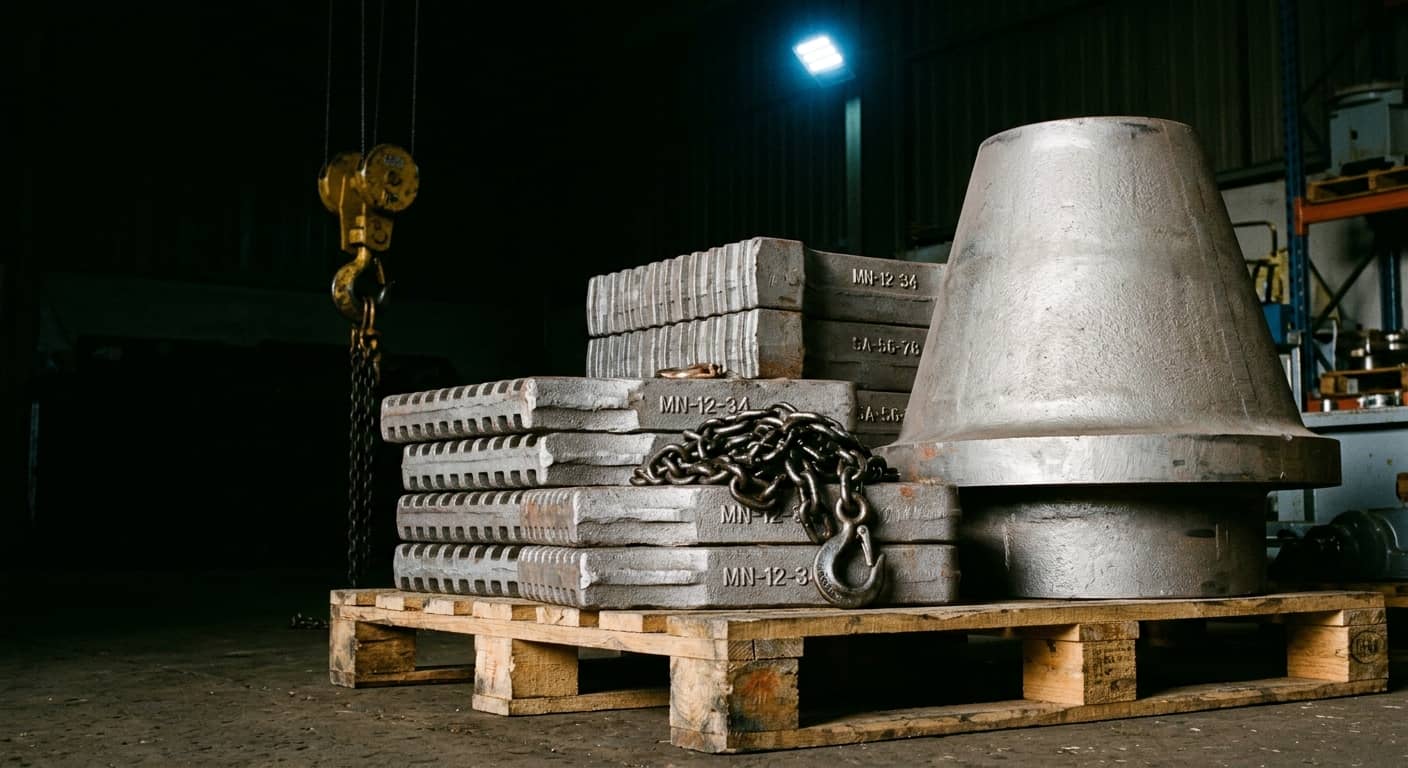
Product group
Crusher, screening and wear parts
Support for fixed and mobile crushing, screening and mineral-processing equipment
Crushing and screening plant wears in two ways: predictable wear on liners and media that you plan for, and mechanical or hydraulic failures that stop the plant. We supply both — wear parts matched to the OEM profile and a defined alloy, and mechanical spares identified from the machine and the old part — using OEM or quality aftermarket routes to suit the specification and the deadline.
Overview
What crusher, screening and wear parts covers
Crushing and screening plant wears in two ways: predictable wear on liners and media that you plan for, and mechanical or hydraulic failures that stop the plant. We supply both — wear parts matched to the OEM profile and a defined alloy, and mechanical spares identified from the machine and the old part — using OEM or quality aftermarket routes to suit the specification and the deadline.
OEM brand names are used only to identify compatibility or when supplying genuine OEM parts. Aftermarket items are described as "quality aftermarket replacement suitable for [machine/model]", with final dimensional confirmation before order.
Construction
How it is built
The main wear parts differ by crusher type. What they have in common: the profile has to match the chamber, and the alloy has to match the feed.
Main wear parts by crusher type
| Crusher | Primary wear parts |
|---|---|
| Jaw | Fixed and swing jaw plates, cheek (side) plates, wedges |
| Cone / gyratory | Mantle and concave (bowl liner), feed cone, arm guards |
| Horizontal / vertical impact | Blow bars / hammers, breaker plates, anvils, rotor tips and wear plates |
| Screens | Woven wire, punched plate, rubber or polyurethane panels; tensioning and fixing |
Options
Wear-liner materials compared
The right material depends on whether the duty is impact, sliding abrasion, or both, and on the operating temperature.
Wear-liner material families
| Material | Best against | Watch-outs |
|---|---|---|
| Manganese steel (Hadfield) | High impact — jaw plates, mantles, concaves. Work-hardens in service | Poor in low-impact sliding wear; needs impact to harden |
| Abrasion-resistant steel (400–600 HB) / chromium carbide overlay (CCO) | Sliding abrasion on chutes, liners, truck bodies | Brittle under heavy impact; CCO cannot be formed after cladding |
| Ceramic (alumina) / rubber-backed ceramic | Fine, hard, high-velocity abrasion — cyclone liners, chute impact zones | Chips under sharp direct impact; heavier |
| Polyurethane / UHMWPE | Wet fine abrasion, sticky material, noise reduction — screen panels, chute liners | Temperature-limited; not for high impact or hot material |
| Rubber | Wet sliding abrasion, impact absorption — mill liners, screen media, skirting | Cut and heat sensitive |
Exact hardness, thickness and grade for the item supplied are confirmed on quotation against the supplier data sheet.
Choosing
OEM vs quality aftermarket — how we decide
Both are legitimate. The deciding factor is whether the equivalence can be proven, not the badge.
| Situation | Route |
|---|---|
| Safety-rated part, or a certificate is a condition of use | Genuine OEM |
| Part inside a tight tolerance stack (bushings, eccentrics, bearings) | OEM, or aftermarket only with confirmed dimensions and fit |
| Wear part with a well-understood profile (jaw plates, mantles, liners, screen media) | Quality aftermarket, matched to profile and alloy |
| Obsolete, or OEM lead time is impractical | Aftermarket or remanufacture from a verified pattern |
Selection
How we select it with you
Send us as much of the following as you have. Partial information is fine — our engineer will come back with the questions needed to finalise the spec, or attend site for an engineering assessment where the problem needs diagnosing first.
- 01Crusher or screen make, full model designation and serial number
- 02OEM part number and description if known
- 03Photographs of the worn part from several angles, including cast markings, with a scale in frame
- 04Key measurements — the mating and wearing faces, or bore/OD/width for mechanical parts
- 05Feed material, hardness and top size, and the wear pattern on the removed part
- 06Genuine OEM or quality aftermarket preference, and whether this is a breakdown or a planned rebuild
Applications
Where we supply
- Fixed plant — primary, secondary and tertiary crushing and screening circuits
- Mobile crushing and screening — track and wheel-mounted units
- Mineral processing — mill liners, cyclone and pump wear, chute and transfer liners
- Quarrying and aggregates — full wear-part programmes and planned rebuilds
What we supply
Range at a glance
- 01Jaw, cone and impact-crusher wear and mechanical parts
- 02Jaw plates, cheek plates, mantles, concaves, bowl liners and feed cones
- 03Bushings, bearings, seals, shafts, pinions, bolts, nuts and backing compounds
- 04Screen panels, punch plates, rubber scalping screens and screen accessories
- 05Feeders, rollers, hydraulic motors, pumps, valves, cylinders and hoses
- 06Wear liners in rubber, polyurethane, ceramic, abrasion-resistant steel and composite constructions
- 07Chocky bars, wear buttons, chute liners, feed-box liners and skirtboard liners
- 08Complete mobile crushers, screens and associated equipment sourced to requirement
Buyer questions
Common questions
Related
Request a quote
Send your crusher, screening and wear parts requirement
Not sure which spec you need? Send the machine, material and duty details — our engineer will specify the correct product and quote it.